
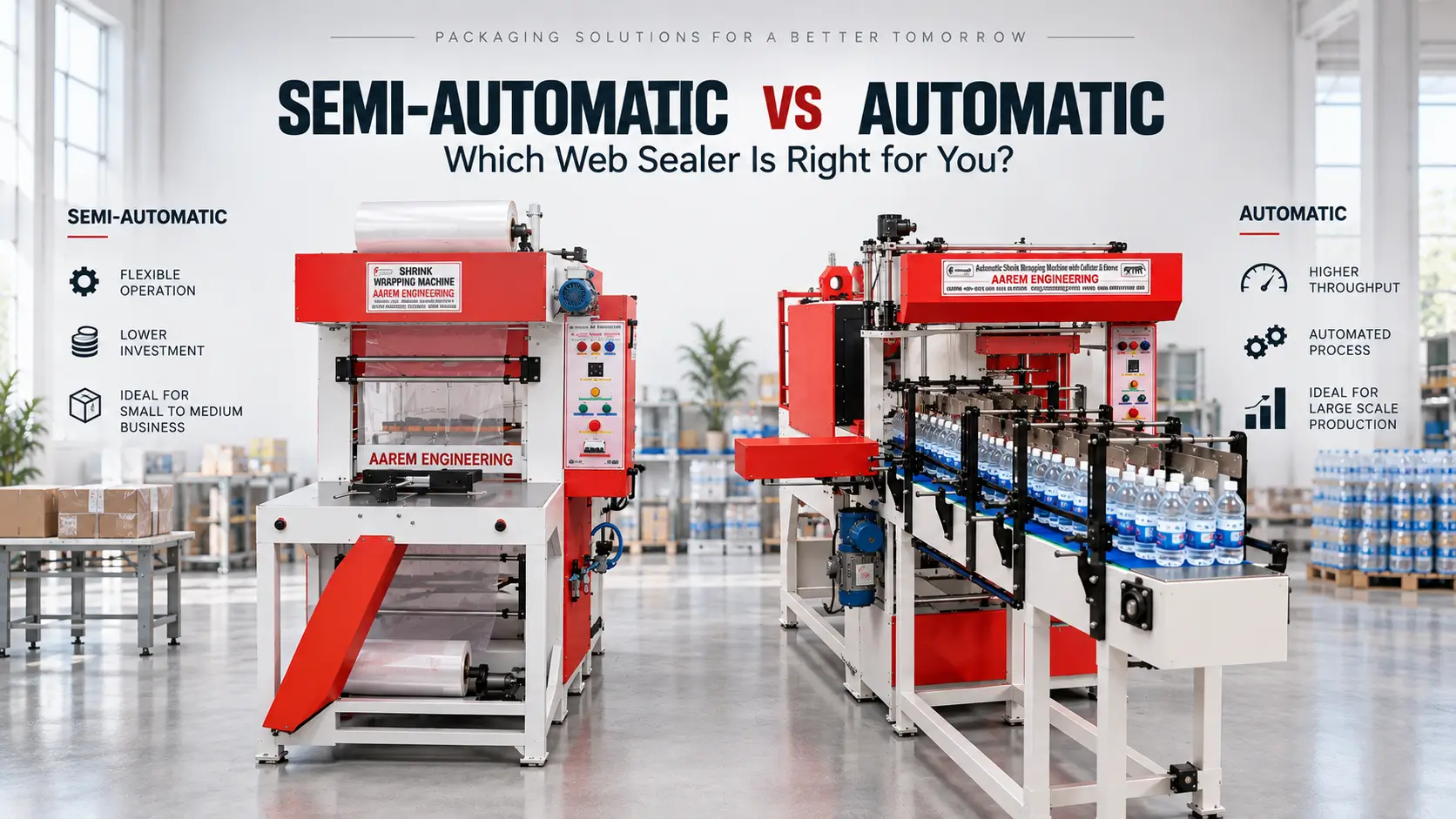
Semi-Automatic vs Automatic Web Sealer
How to Actually Decide
Last updated September 17, 2026 — Reviewed by Rupesh Shah, Managing Director, AAREM Engineering
If you’ve been going back and forth between a Semi Automatic vs Automatic Web Sealer for a few weeks now, you’re not overthinking it. This is genuinely one of the harder equipment calls a plant manager makes, because both machines do the same job — bundling and Shrink-Wrapping Products — and both easy answers (“get the cheap one” or “get the fast one”) sound reasonable until you’re the one accountable for the outcome six months later.
This isn’t a spec sheet. You can find our full model specs, sizes, and setup options on our Web Sealer with Shrink Tunnel Machine Models page whenever you’re ready for that level of detail. What this article does instead is walk through the actual questions in your head right now, in the order they usually come up, and give you honest answers — including where the “obvious” choice is actually wrong.
Why This Decision Feels Harder Than It Should
Here’s the thing nobody tells you upfront: the confusion isn’t really about the machines. It’s about not knowing which of your own numbers (parameters) actually matter.
Most buyers start by comparing price tags. That’s the first wrong number. The right first number is your current production rate — how many packs per minute defines your upstream process (filling, capping, labeling) production rate, whether you’ve measured it or not. Everything else in this decision flows from that one number, and most people haven’t checked it before they start shopping for a sealer.
So before we get into machine types, here’s the one thing worth doing today: stand at your production line for 15 minutes with a stopwatch and count how many finished, ready-to-pack units come off your line per minute. Write that number down. You’ll need it in once you read a few paragraphs.
Semi-Automatic vs Fully Automatic: Quick Comparison
| Feature | Semi-Automatic Web Sealer | Fully Automatic Web Sealer |
|---|---|---|
| Output (PPM) | 5 to 6 packs per minute | Up to 15 packs per minute |
| People Requirement | 2 people (infeed & outfeed) | 0 People (when built into a line) |
| Product Versatility | Highly Versatile — handles cartons, bottles, and more on one machine | Customised Versatility — built for one SKU family |
| Initial Investment | Low | About 2-3x Cost |
Comparison of Semi-Automatic vs Automatic Web Sealer
"Isn't Automatic Web Sealer with Shrink Tunnel Machine Just Better?"
This is the question everyone asks first, and the honest answer is: not always, and here’s why.
An Automatic Web Sealer removes manual Human Dependency and runs faster — that part is true. But automation isn’t a universal upgrade; it’s a specialist tool. A Fully Automatic System is built and tuned for a fairly narrow range of product shapes and sizes. Feed it something outside that range — a different bottle shape, an odd carton size, a seasonal product line — and you either need a costly rebuild or a second dedicated machine.
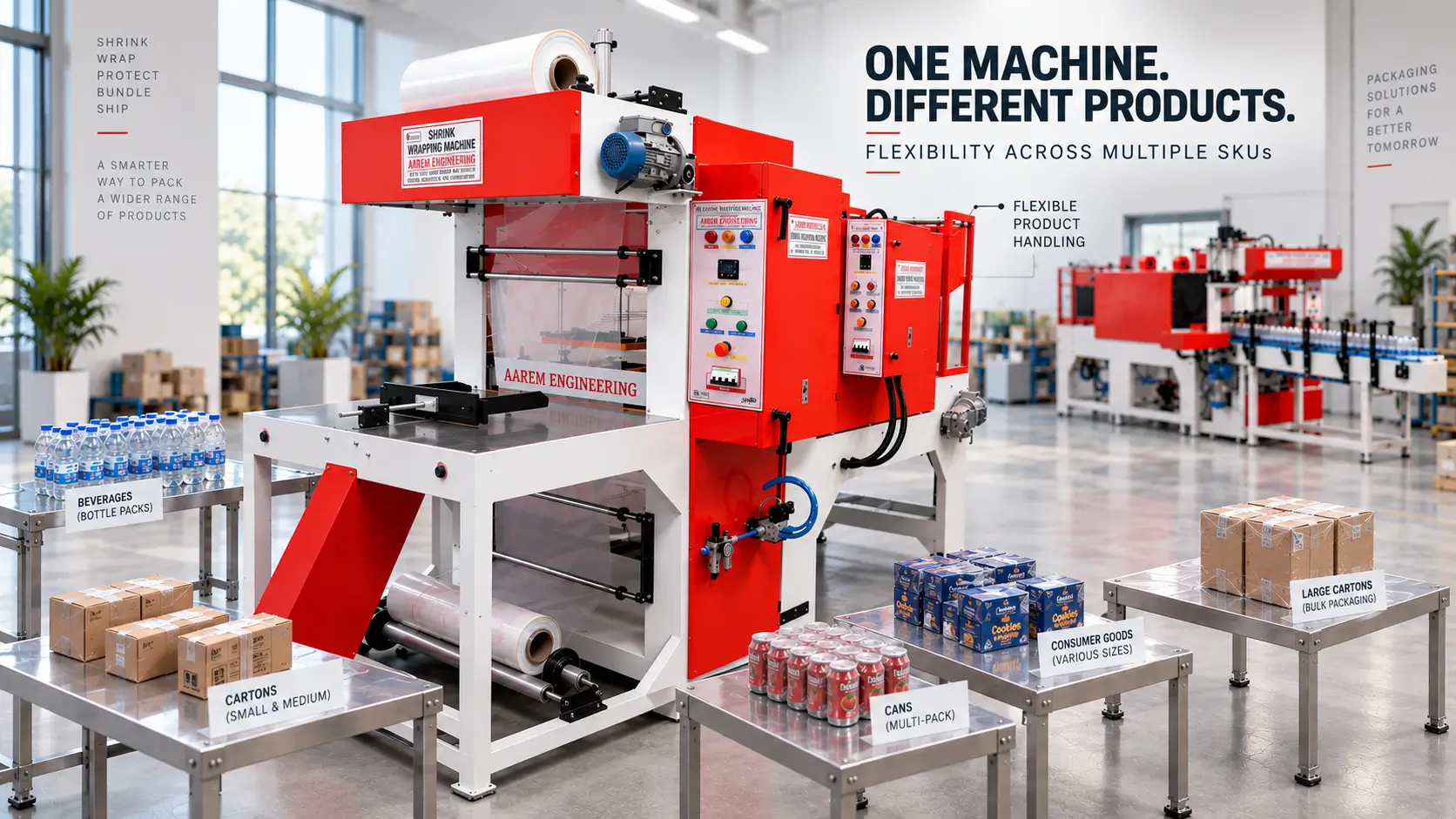
A Semi-Automatic Web Wealer, on the other hand, is built to be general-purpose. Any worker can adjust it for a new product in minutes. If your plant runs anything close to “many products” — several product types, seasonal items, packing for different clients — that human flexibility is doing real work that a fixed automatic feed can’t match without extra engineering cost.
So the honest way to put it is: Automatic may not be “better.” It’s faster and cheaper per unit at high volume, for one product type. Semi-Automatic is slower and needs more people, but it is flexible across many product types / SKU’s. Neither one is simply the correct path for everyone — they’re built for different jobs.
"We're Growing — Should We Just Buy Automatic Web Sealer Machine Now, to Be Safe?"
This is the second most common question, and it is where a lot of buyers spend too much.
By buying an Automatic Machine which you don’t need yet doesn’t protect your future — it just moves your risk earlier.
A Fully Automatic Web Sealer typically costs two to three times more upfront than a Semi-Automatic unit. If your current line runs at 3–4 packs per minute and you invest in a machine designed for 15 packs per minute, you’re paying for 11–12 packs per minute of capacity that your operation may not yet be able to use. That unused capacity ties up capital while your loan or lease payments continue—and ultimately affect your ROI (Return on Investment).
The better way to plan for the future is this: buy the Semi-Automatic unit that comfortably handles today’s volume, and treat the Automatic upgrade as your next big decision — once you make when your data (not a guess) tells you it’s time. The above data based decision is simpler than people’s expectations.
The Actual Tipping Point (Not a Guess — a Threshold)
Let’s look at your current production rate—how many finished units come off your line per minute right now. Here is the threshold that matters.
If your upstream production consistently runs above roughly 5–6 finished units per minute, a Semi-Automatic Web Sealer becomes your bottleneck. Two people, no matter how skilled, physically cannot group and feed products into a sealing station faster than that for a full shift without mistakes, tiredness, or weak seals creeping in. Once your line crosses that point, you’re not “thinking about” automation anymore — manual handling is already capping how much you can produce.
Below that point, there is generally no performance reason to pay 2 – 3x more for automatic capacity you’re not using.
There are two other signs worth watching for, apart from raw speed:
Sign 1: You can't keep the sealing station staffed.
If your end-of-line output regularly drops when one person calls in sick or moves to another task, that’s not a scheduling problem — it’s a real dependence on worker that an automatic system removes entirely. This crawls up slowly by : missed shipping deadlines, rising overtime costs, or a supervisor pulled away from other work to cover the line.
Sign 2: A retail or distribution partner is asking for a specific bundle setup.
If someone downstream — a distributor, a retail chain — starts requiring a fixed multi-pack format (say, a 3×4 grid of bottles or a 2×3 carton set) at steady volume, putting that grid together by hand becomes very hard past a certain order size. This is exactly what a collator-equipped automatic system is built to solve, and it’s often the clearest sign it’s time to upgrade, because it’s coming from a customer need, not an internal guess.
If none of these two signs apply to you yet, a Semi-Automatic Web Sealer is very likely the right call today — not a compromise, not a “starter machine,” just the right tool for your current line.
What Am I Actually Giving Up If I Choose Semi-Automatic Web Sealer with Shrink tunnel Machine ?
Fair question, and worth answering honestly instead of glossing over it.
You’re accepting a hard limit of roughly 5–6 packs per minute. You’re committing to having two people on that station every shift it runs — a real, ongoing cost. Also if your product mix suddenly narrows down to one main product at high volume, you may outgrow the machine faster than expected.
What you’re keeping in real by choosing a Semi-Automatic machine : lower upfront cost, the ability to run completely different products on the same machine without rebuilding it, simpler upkeep with fewer parts to fail, and a much shorter path to getting up and running (Semi-Automatic units are generally quicker to install and set up than a Fully Automatic Line).
What Am I Actually Giving Up If I Choose Automatic Web Sealer with Shrink Tunnel Machine?
Also fair and Also worth being direct about.
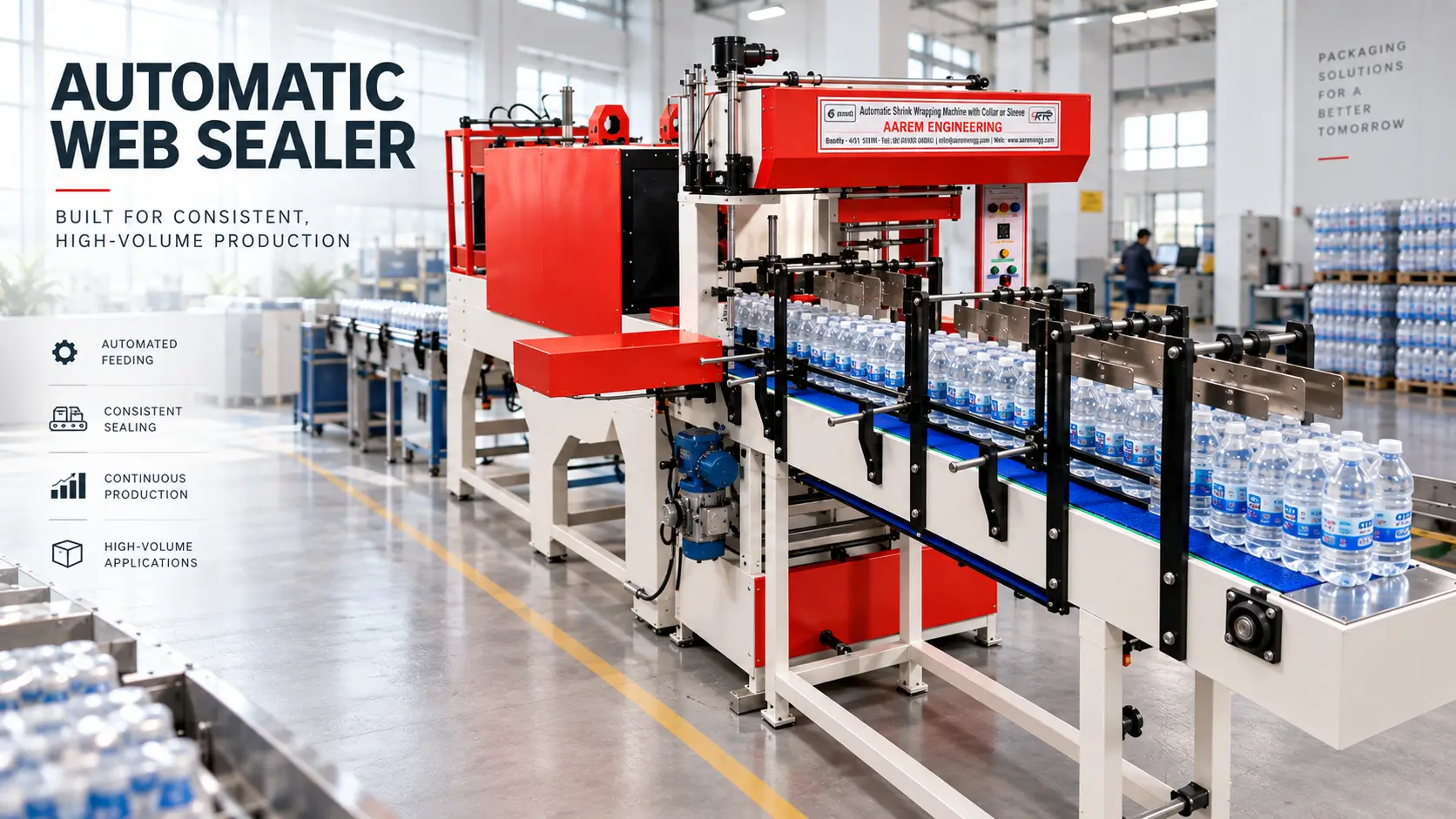
You’re committing roughly two to three times the money upfront, and that money is now tied to one specific product setup. Automatic web sealers generally come in three main types, and each one is built for a specific job:
Automatic Web Sealer with Shrink Tunnel Machine – Carton: built to seal boxes and cartons of a set size
Automatic Web Sealer with Shrink Tunnel Machine – Bottles: built to group and seal bottles or similar round containers
Automatic Web Sealer Shrink Tunnel Machine with Collator – Carton/bottles: built to arrange products into a fixed grid (like a 3×4 pack) before sealing
Whichever type you choose, that machine doesn’t easily switch to a different product without real engineering work. You’re also taking on a more complex piece of equipment: more sensors, more automated controls, and — while modern industrial controls are generally reliable — more parts that can need specialized service compared to a simpler manual sealing station.
What you’re gaining is real, too: almost zero Human Dependency at that station, steady seal quality that doesn’t change from operator to worker, and enough speed to support a 24/7 or high-volume single-product line without a floor full of backed-up stock.
A Simple Way to Settle It
If you’re still not sure after reading this, here’s the fastest way to get clarity: don’t ask “which machine is better.” Ask “what happens on my line next month if I do nothing?”
If the honest answer is “nothing changes, we run the same volume and mix we always have” — Semi-Automatic is very likely correct, and any Automatic Quote you’re looking at is probably solving a problem you don’t have yet.
If the honest answer involves a known upcoming jump in volume, a new retail contract with bundling requirements, or an admission that your team already struggles to keep the current station staffed — that’s your answer, and it’s automatic.
Most confusion in this decision comes from trying to answer it in the abstract. Measured against your actual next quarter, it’s usually much clearer than it feels right now.
A Note on Trust, Since This Is a Real Investment
AAREM build’s both Semi-Automatic and Fully Automatic Web Sealers, so we don’t have a reason to push you toward the more expensive option — and honestly, a large share of the plants we work with are correctly served by the Semi-Automatic Line. AAREM Engineering has been building Shrink and Stretch Wrapping Machines in Mumbai since 2002, and today that’s grown into:
- 4,500+ happy customers
- 22+ years of manufacturing experience
- 27+ distributors and 5+ countries of active presence
- 4.8 rating on Google
That history matters here mainly because this decision benefits from a manufacturer who’s watched both machine types succeed and fail in real factories — not just sold them.
Where to Go From Here
If you now have a clearer sense of which side of this decision you’re on, the next step is looking at real machine specs, floor space needs, and setup options for your specific product. That’s covered in full detail on our Web Sealer with Shrink Tunnel Machine Models page, including semi-automatic, carton-dedicated automatic, bottle-dedicated automatic, and collator-equipped automatic setups.
If you’re still unsure which category fits your line, that’s a completely normal place to be — talk it through with our engineering team before you commit to either direction.
Get a free consultation on your line’s throughput and the right machine fit →
Frequently Asked Questions on Semi Automatic vs Fully Automatic Web Sealer Machine
How do I know if I need a Semi-Automatic or Automatic Web Sealer?
Start by measuring your current upstream production rate—how many finished units come off your line per minute. If you’re consistently below roughly 5–6 packs per minute and your product mix varies, a Semi-Automatic Machine is often the more practical choice. If you’re consistently above that level, struggling to keep the sealing station staffed, or need steady, repeatable bundling, an automatic system may be the better fit.
Is a Fully Automatic Web Sealer always a better long-term investment?
Not necessarily. Automatic is a better investment when your actual production volume, product consistency, and labor requirements justify the roughly 2–3× higher upfront cost. If your current line cannot use the additional capacity, you’re tying up capital without generating a proportional return.
Can I upgrade from Semi-Automatic to Automatic Later?
In many cases, yes. Plants often start with semi-automatic equipment and move to automation as production volume, labor requirements, or consistency demands increase. A Semi-Automatic Machine can therefore be a sensible first-stage investment rather than a machine you’ll have to replace immediately.
What’s the biggest mistake people make in this decision?
Comparing machine prices before measuring their actual bottleneck. The right choice depends on your line’s production rate, product consistency, labor requirements, and future volume—not simply on which machine has the more impressive specification sheet.
Do I need two people for a Semi-Automatic Web Sealer every shift?
Not necessarily, but many Semi-Automatic setups require dedicated operator involvement for product grouping, loading, and finished-bundle handling. The actual labor requirement depends on the machine configuration, product size, line speed, and how the station is integrated into the production line. These labor requirements should be included when comparing Semi-Automatic and Automatic Systems.
What if my product mix changes with the seasons?
A variable product mix can be a strong reason to choose Semi-Automatic equipment, or to retain a Semi-Automatic line alongside automatic capacity. Manual loading can accommodate a wider range of product shapes and pack configurations without requiring extensive changes to an automated feeding system. The right choice depends on how frequently the product changes and how much setup time each format requires.
Reviewed and updated by Rupesh Shah, Managing Director at AAREM Engineering — LinkedIn ↗.
AAREM Engineering has been manufacturing shrink and stretch wrapping machinery in Mumbai since 2002.